Abstract
Correcting segmentation errors in large-scale 3D nuclei reconstructions requires reasoning about which fragments belong to the same nucleus across densely packed regions. Existing correction methods rely on local pairwise fragment matching, which cannot resolve the global topology of nuclear clusters and fails to recover missing morphology. We propose NUGRAPH, a graph-based reasoning framework that operates over atomic 3D primitives obtained by decomposing erroneous masks. NUGRAPH encodes primitive geometry via a 3D point-cloud backbone and performs global relational reasoning through graph attention, capturing inter-primitive dependencies across entire clusters rather than isolated pairs. A primitive–proposal contrastive loss aligns local fragment features with nucleus-level semantics, improving grouping accuracy in dense regions. The resulting proposals are then refined by a shape-refinement network that predicts signed distance fields to restore smooth, biologically plausible morphology. To train without manual error annotations, we develop a self-supervised data engine that synthesizes realistic segmentation errors from clean nuclei labels. To benchmark correction at brain scale, we curate NucEMFix, the first brain-wide EM benchmark of nuclei error cases across FAFB and MICrONS (8,000+ annotated error nuclei). Experiments on NucEMFix and public C. elegans confocal volumes show that NUGRAPH consistently outperforms both re-segmentation baselines and pairwise correction methods, achieving state-of-the-art F1 scores.
Dataset
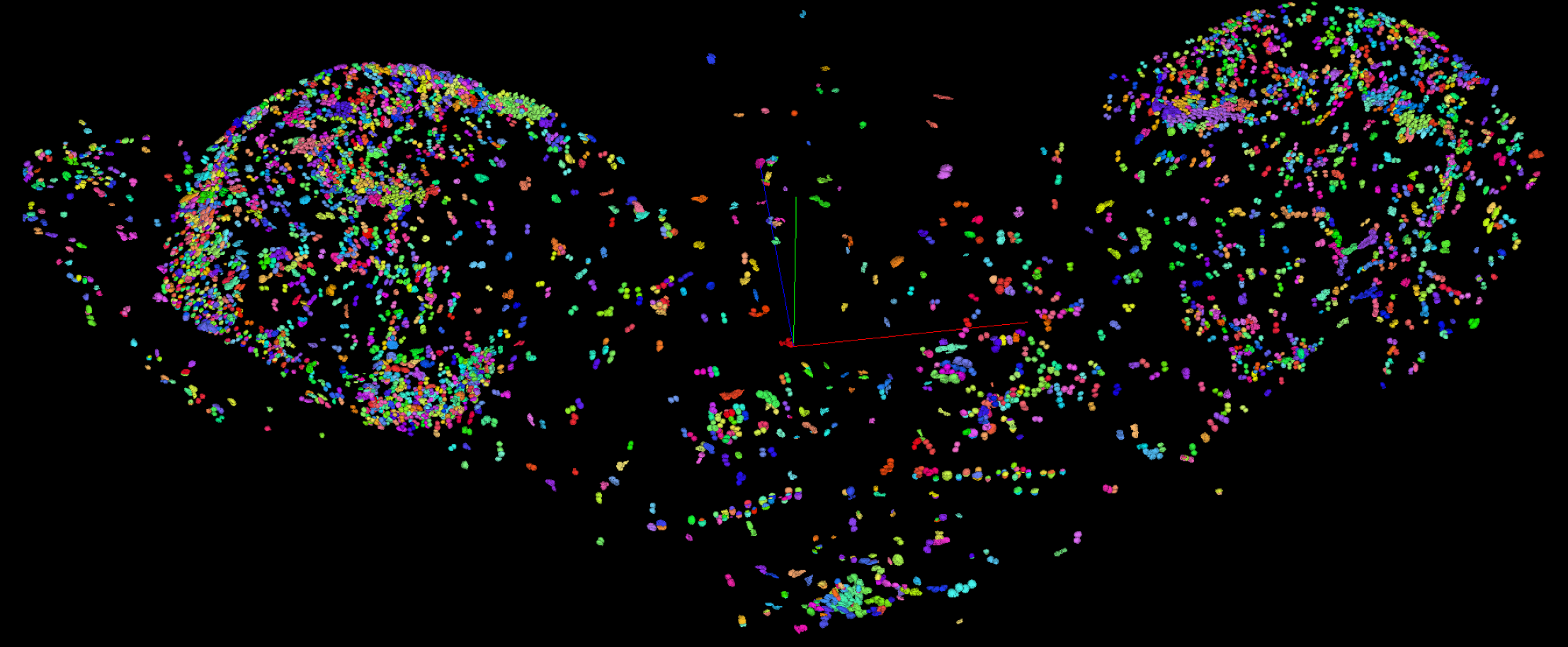
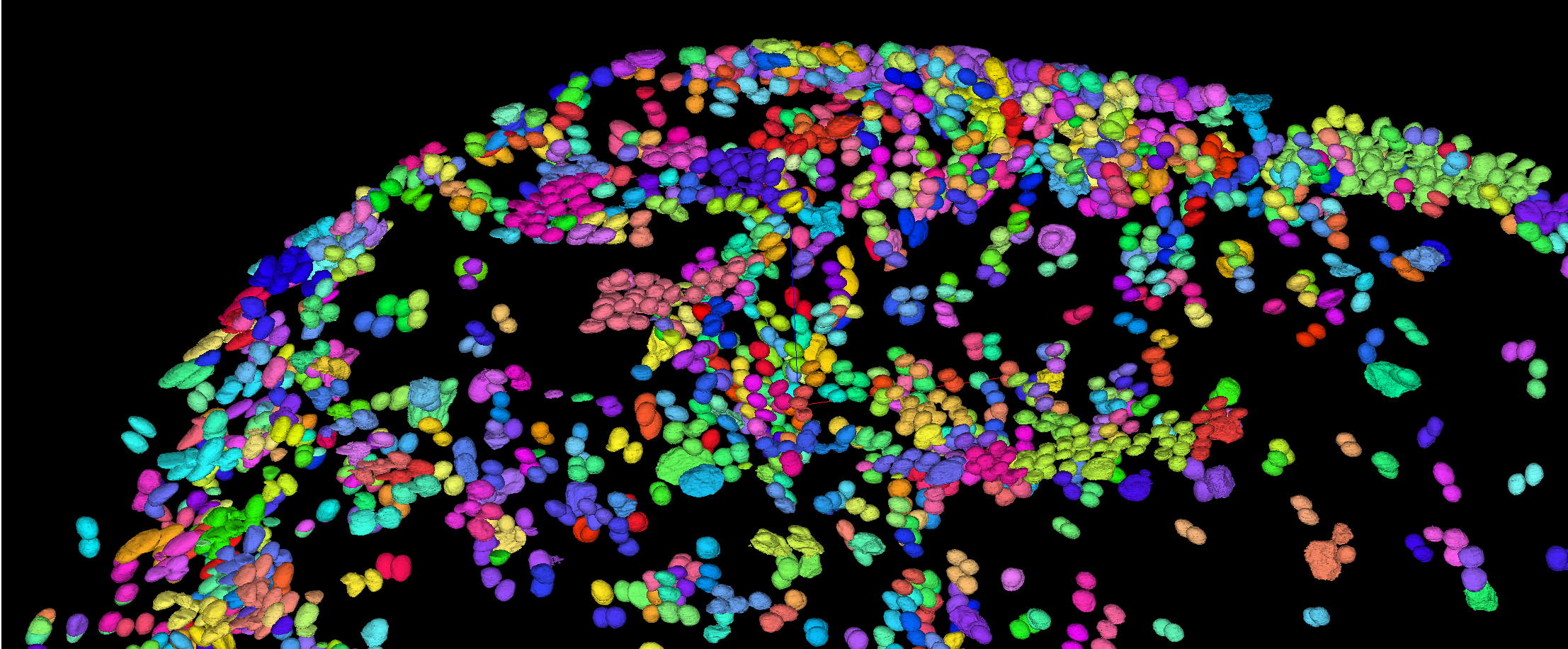
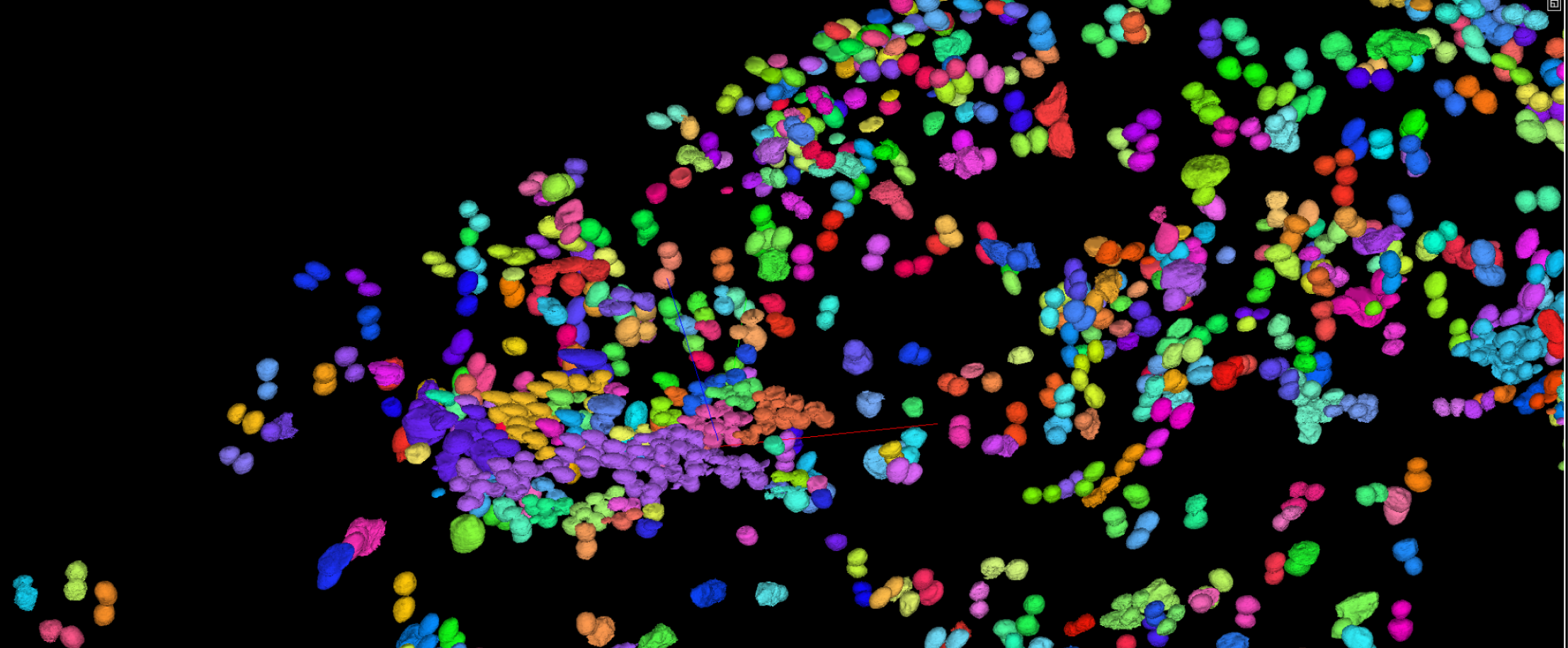
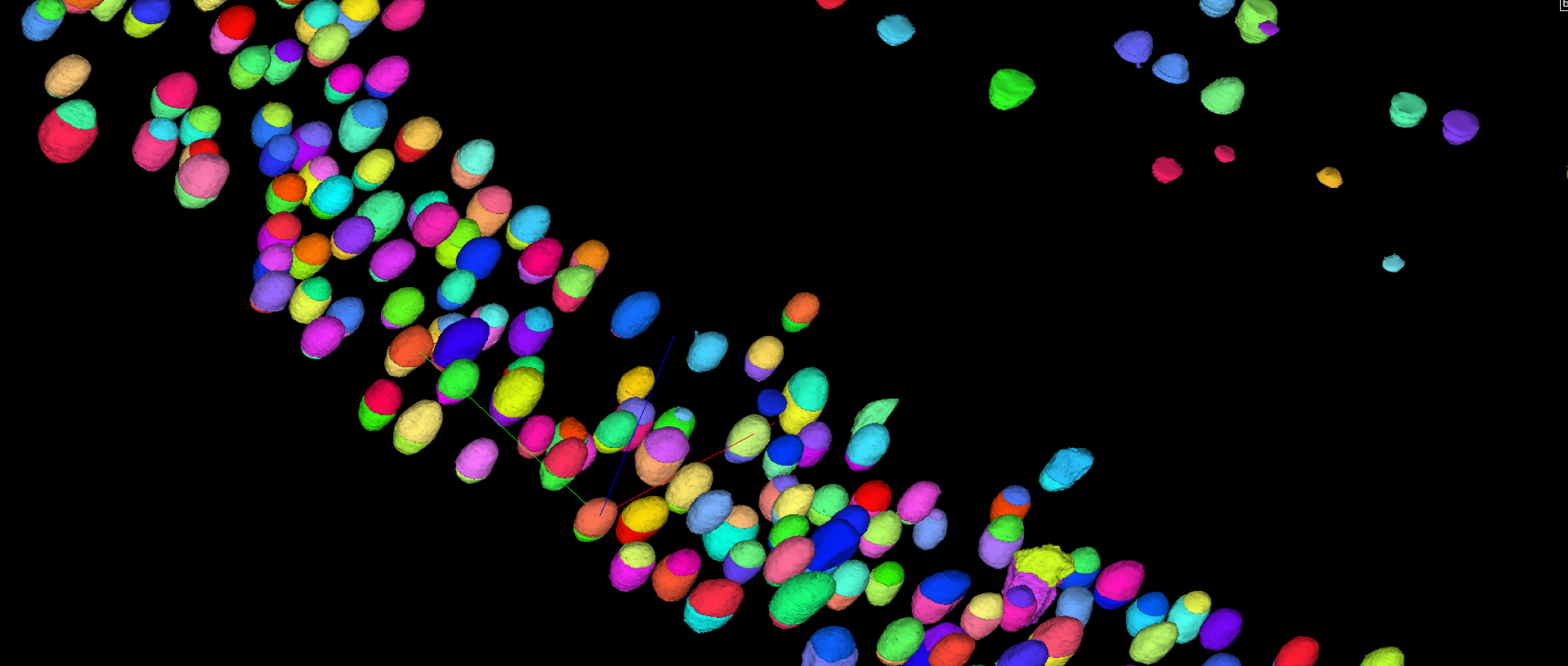
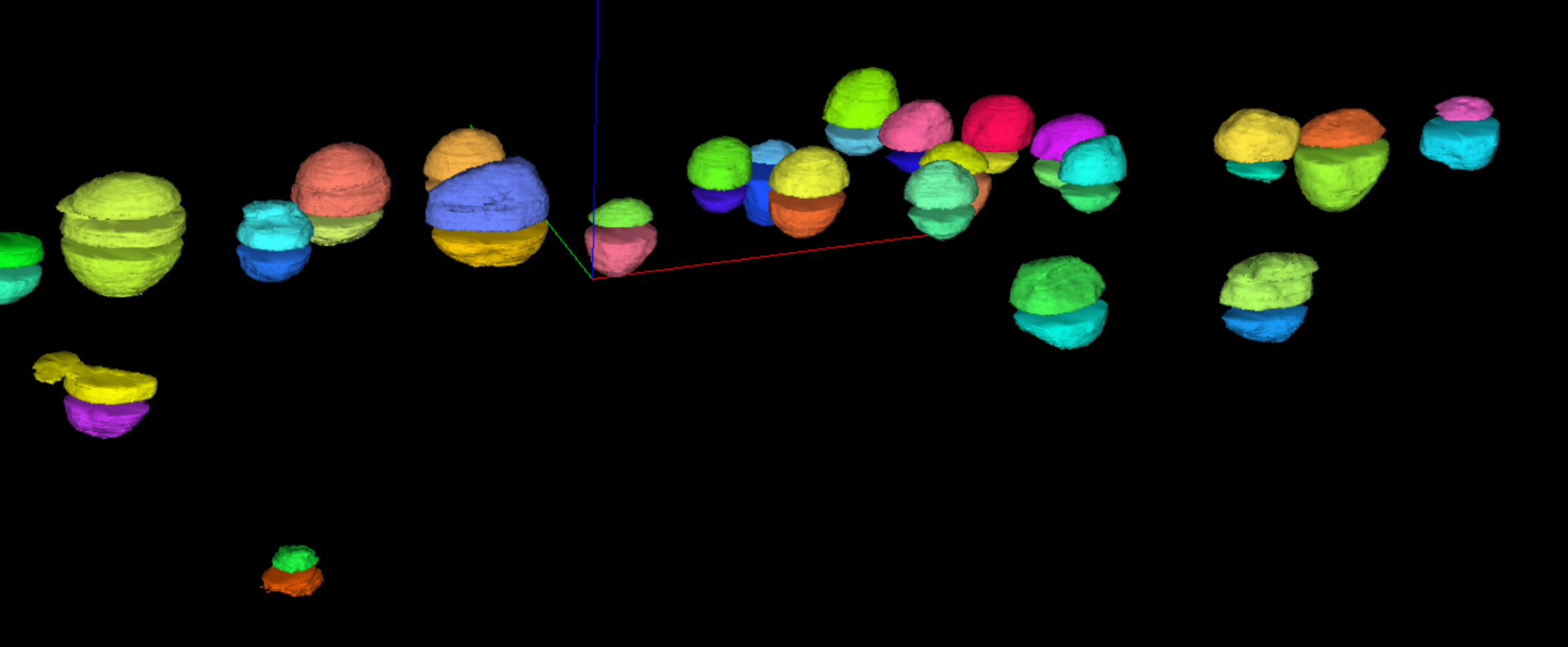
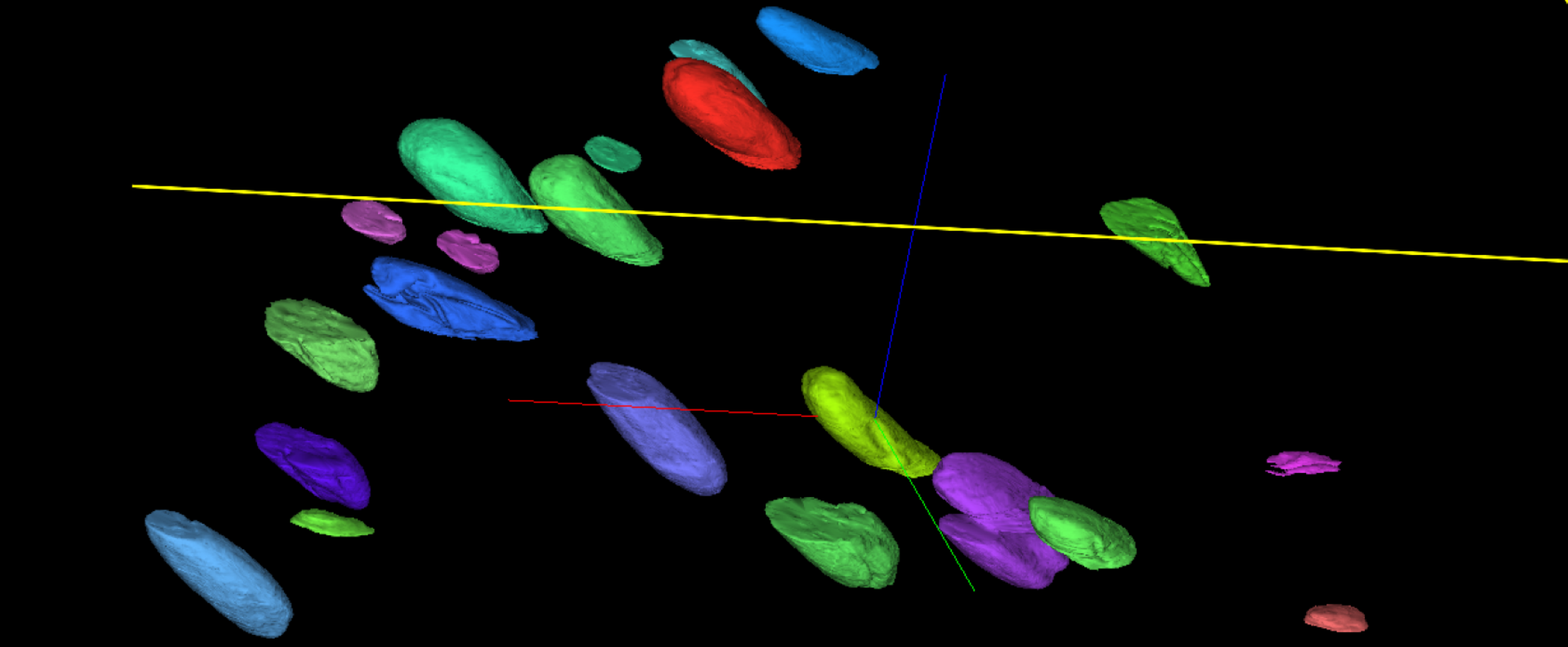
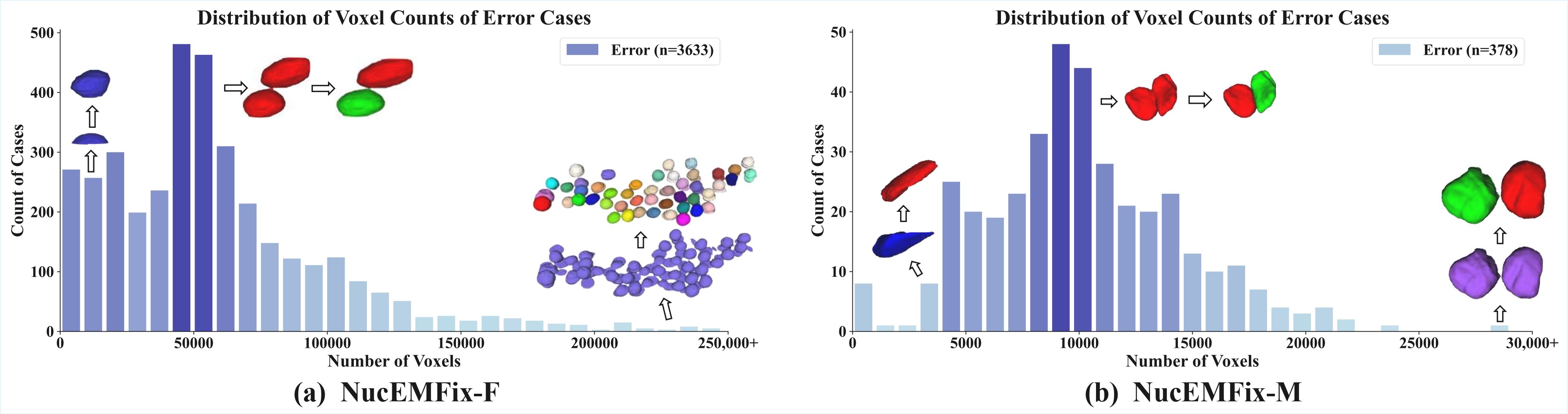
Distribution of error case sizes in the proposed NucEMFix dataset, showing a long-tail distribution. Error cases are distributed throughout the whole brain and vary widely in shape and size, categorized into three types: false merge, false split, and false merge & split.
NuGraph Framework

NuGraph pipeline.
(a) Shape decomposition:: erroneous masks are decomposed into atomic 3D primitives via EDT-based watershed.
(b) Graph-based relational reasoning: 3D point-cloud features of primitives are encoded and reasoned over via graph attention netowrk to group primitives into nucleus proposals.
(c) Shape refinement: a 3D U-Net predicts signed distance fields to restore complete nucleus morphology.
BibTeX
@article{Wang2026.05.16.725603,
  title = {NuGraph: Graph-Based Reasoning over 3D Primitives for Nucleus Segmentation Correction},
	year = {2026},
	doi = {10.64898/2026.05.16.725603},
	publisher = {Cold Spring Harbor Laboratory},
	URL = {https://www.biorxiv.org/content/early/2026/05/19/2026.05.16.725603},
	eprint = {https://www.biorxiv.org/content/early/2026/05/19/2026.05.16.725603.full.pdf},
	journal = {bioRxiv}
}